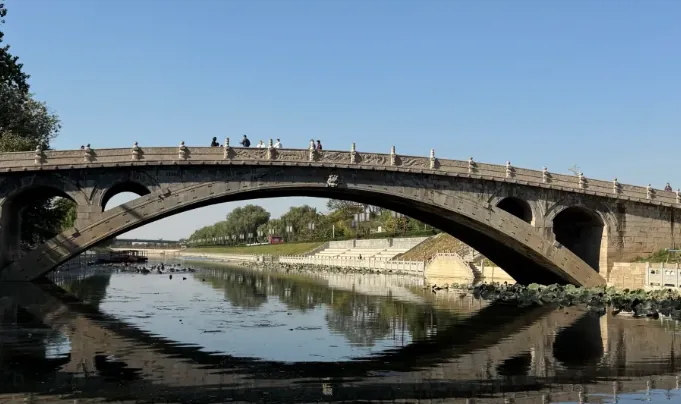
Anji Qiao · Zhao County, Hebei · 595-605 CE
The Zhaozhou Bridge (also called Anji Bridge) is the oldest open-spandrel segmental arch bridge in the world — a stone bridge built in 605 CE that has survived 1,400 years of floods and earthquakes. Designed by the master mason Li Chun during the Sui dynasty, its innovations — a flat segmental arch and two open spandrel arches in the shoulders — were not replicated in Europe until the 14th century. The bridge remains a functioning crossing today, a testament to the engineering genius of Chinese architecture beyond temples and palaces.
Conventional ancient bridges used semicircular arches, which raised the roadbed steeply at the crown and let floodwater pound the spandrel walls. Li Chun's segmental arch — only a shallow slice of a circle — created a nearly flat deck while maintaining structural integrity. The rise-to-span ratio is just 1:5 (a rise of 7.3 meters over a span of 37 meters), an unprecedented figure for the 7th century; Europe would not build a comparable open-spandrel arch until the 14th century.
The bridge's second innovation is visible only from the river: two small open spandrel arches cut into each shoulder, lightening the structure by roughly 30 percent and giving floodwater a clear channel through the body of the bridge instead of against it. The design solved a real local problem — the Jiao River floods violently after mountain rains — and the bridge is the proof of the solution: it has never been washed away in 1,400 years.
The bridge is assembled from 28 independent longitudinal stone arches, each composed of interlocking stones cut to precise shapes and joined by iron ties and dovetailed stone dowels — joinery techniques translated directly from timber construction. No mortar was used, allowing the arch to flex slightly under load and during earthquakes, exactly like the mortise-and-tenon joints of a timber hall.
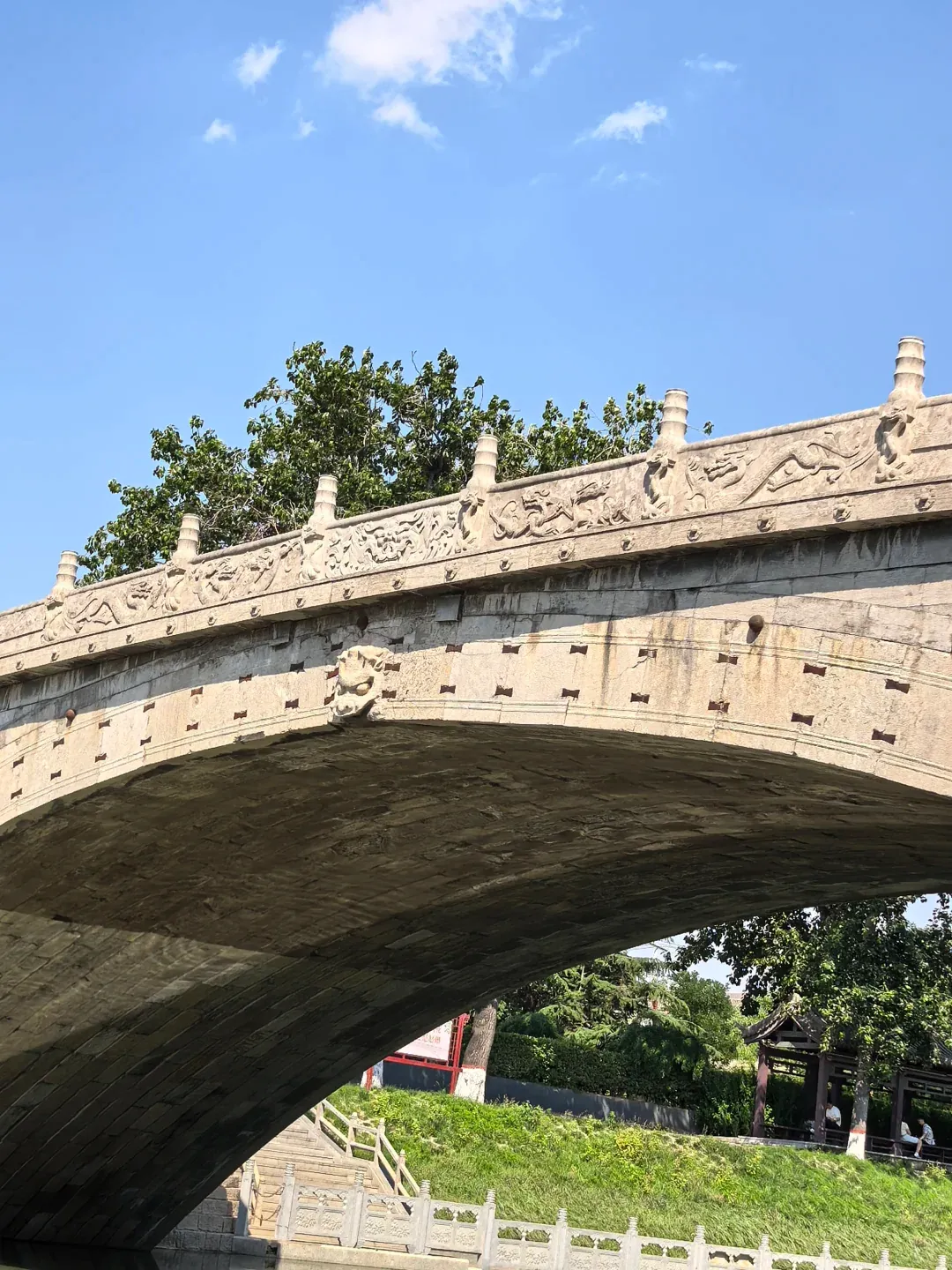
The deck runs 9 meters wide, and the balustrades carry carved dragons, flowers, and mythical beasts that make the bridge a work of sculpture as much as engineering. The iron ties that clamp the arch ribs together were designed to be replaceable — later repairs simply knocked out a corroded tie and drove in a new one, an early example of designed-in maintenance that kept the structure repairable across centuries.
For over 1,400 years, the Zhaozhou Bridge carried traffic on the route between the North China Plain and the hinterland. It has survived eight major floods, numerous earthquakes, and heavy cart traffic — in the 1963 flood, water submerged the deck yet the arch held. Repair records begin in the Tang dynasty itself, and every documented repair has preserved the original arch geometry rather than replacing it.
In 1991, the American Society of Civil Engineers designated it an International Historic Civil Engineering Landmark — one of only 12 such structures worldwide, alongside the Eiffel Tower and the Panama Canal. The bridge's survival demonstrates that Chinese engineering brilliance extended far beyond wood: in stone, builders of the Sui dynasty achieved a design that the rest of the world would not match for 700 years.
Best Time to Visit
April-June and September-October
Photography Tips
Arch shot from the riverbank level; low angle from beneath the arch
How to Get There
High-speed rail to Shijiazhuang, then 1hr drive to Zhao County; 40km from Shijiazhuang airport
Its flat segmental arch — with a rise-to-span ratio of just 1:5 — replaced the semicircular arches of earlier bridges, creating a nearly level deck. The two open spandrel arches cut into the shoulders lightened the structure and let floodwater pass through. Europe would not achieve this design for another 700 years.
Yes — it continues to carry pedestrian traffic today. In 1991 the American Society of Civil Engineers named it an International Historic Civil Engineering Landmark, one of only 12 in the world, and it has been restored several times while preserving the original 7th-century arch structure.
The 28 longitudinal arch ribs are assembled from interlocking stones joined by iron ties and dovetailed stone dowels — joinery translated directly from timber construction. Without rigid mortar, the arch flexes slightly under load and in earthquakes, the same reason mortise-and-tenon timber frames survive quakes.