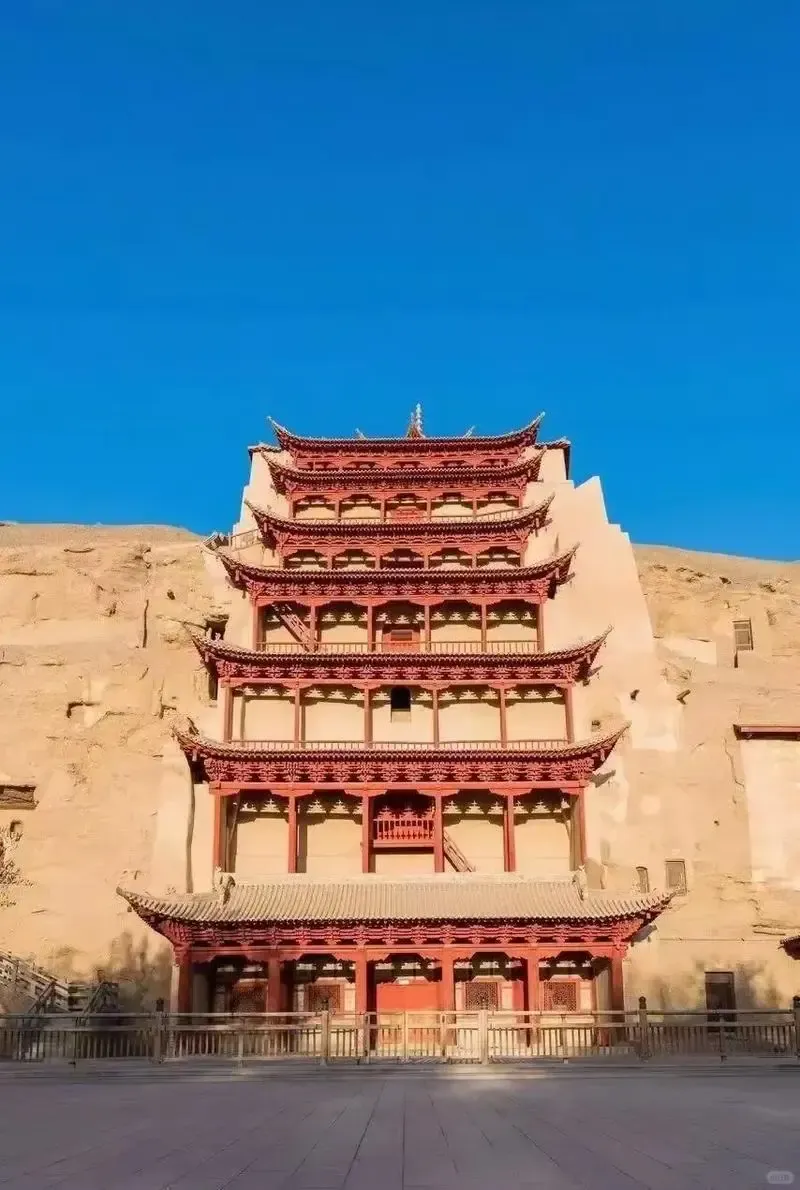
Mogao Ku · Dunhuang, Gansu · 366 CE onward
The Mogao Caves, also known as the Caves of the Thousand Buddhas, are the largest and richest repository of Buddhist art in the world — 735 caves carved over a thousand years into a cliff at Dunhuang, the gateway between China and the Silk Road. The caves preserve 45,000 square meters of murals and over 2,000 painted sculptures, spanning the 4th to the 14th centuries. Their wooden facades, cliff walkways, and painted interiors make Mogao the most complete record of Chinese religious architecture, art, and daily life in existence.
The first cave was carved in 366 CE by the monk Le Zun, who reportedly saw a golden vision of a thousand Buddhas on the cliff — which is why the site is also called the Caves of the Thousand Buddhas. For the next thousand years, Dunhuang's position at the junction of the Silk Road made it the richest Buddhist center in China. Merchants about to cross the Taklamakan Desert, generals on campaign, and pilgrims heading to India all funded new caves as offerings of merit.
The caves document the ebb and flow of trade and faith better than any chronicle: murals show caravans with Bactrian camels, musicians of every ethnicity, and donor portraits of families in their finest silk. Cave 220, painted in the 640s, preserves a Tang dance scene so vivid that scholars reconstructed the choreography from its pigments. Each dynasty added its layer, so the cliff reads like a 1,000-year stratigraphy of Chinese art.
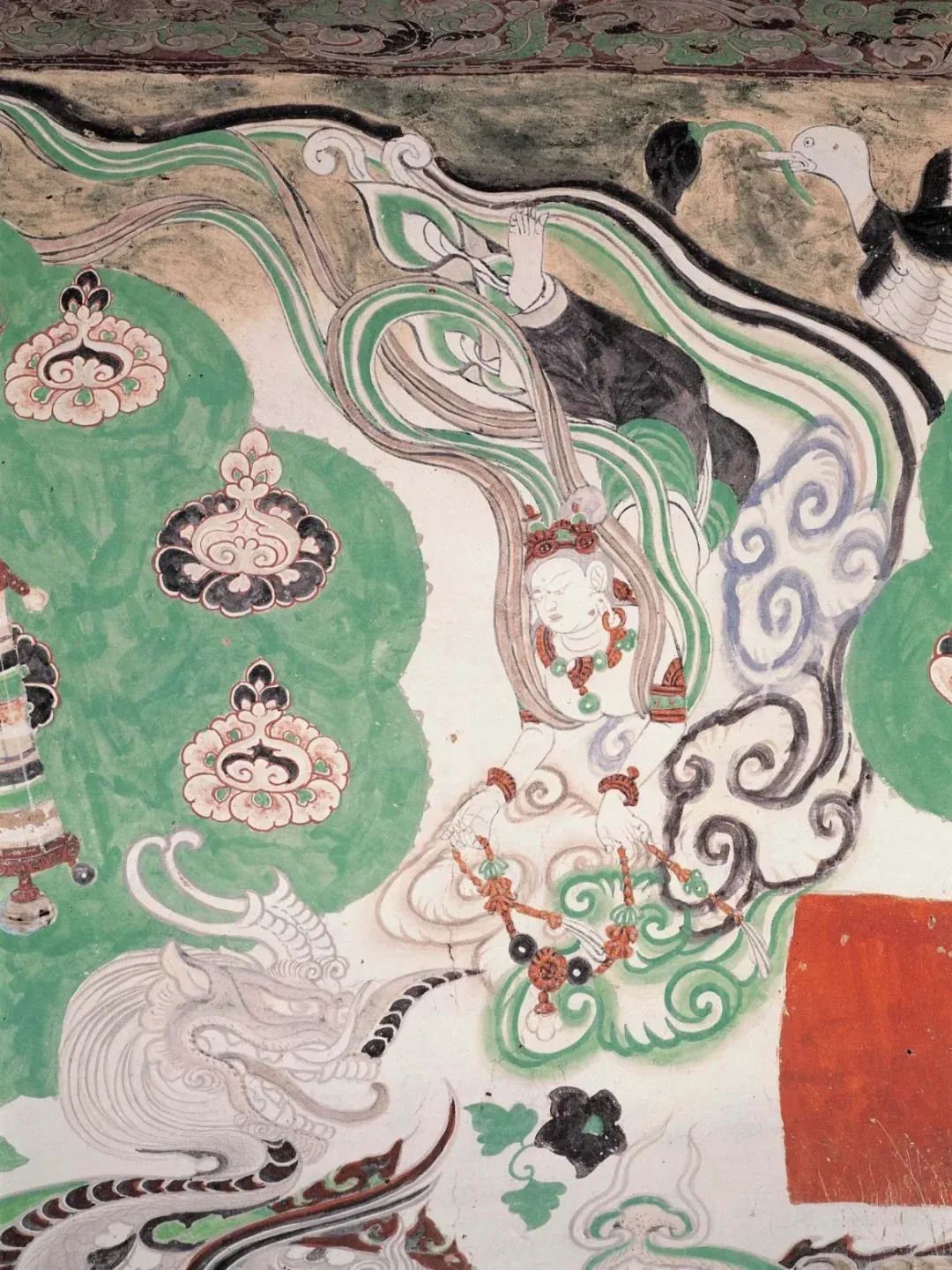
Mogao's greatest treasure is its mural art — 45,000 square meters covering walls, ceilings, and niches. The painters ground minerals into pigments that have not faded in 1,400 years: lapis lazuli blue imported from Afghanistan, malachite green, cinnabar red, and gold leaf. Flying apsaras (feitian), the celestial musicians of Buddhist cosmology, float across ceilings in a style that evolved from heavy Indian figures into the weightless, ribbon-trailing dancers of Tang art.
The murals are also an architectural archive: they depict palaces, pavilions, and pagodas of the Tang and Song in exact detail — buildings that no longer exist anywhere in China. The most famous structure on site, the nine-story wooden pavilion of Cave 96, was built into the cliff in the 1920s to shelter the 35.5-meter Maitreya Buddha, the world's third-tallest seated Buddha — a late union of rock-cut sculpture and timber construction.
In 1900, the Daoist caretaker Wang Yuanlu broke through a wall and found Cave 17 — the Library Cave — sealed for nearly 900 years. Inside lay more than 50,000 manuscripts, paintings, and textiles dating from the 4th to the 11th centuries, written in Chinese, Tibetan, Sogdian, Khotanese, and Sanskrit: contracts, medical recipes, poems, and the world's oldest dated printed book, the Diamond Sutra (868 CE).
Wang reported the find to local officials, but word spread slowly — and by the time scholars reacted, explorers were on the way. Aurel Stein in 1907 and Paul Pelliot in 1908 took thousands of items to London and Paris; further collections went to St. Petersburg and Tokyo. The dispersal scandalized later generations, yet the cataloging of those same manuscripts created modern Dunhuang studies, and the caves themselves — now managed by the Dunhuang Academy with digital documentation and strict visitor rotation — remain the world's largest repository of Buddhist art.
Best Time to Visit
May-June and September-October; summers are hot, winters freezing
Photography Tips
Nine-story pavilion (Cave 96) from the opposite riverbank at sunset; interior photography is restricted
How to Get There
Fly to Dunhuang Airport (DNH); caves are 25km southeast of town by taxi
Of the 735 caves, only about 30-60 are open at any time, rotated for conservation. A standard guided tour visits 8-12 representative caves spanning the Northern Liang to Yuan dynasties — enough to see the evolution of mural painting and sculpture. English tours are available and should be booked in advance.
No — photography is strictly forbidden inside the caves because camera flashes and even constant lighting accelerate pigment fading. The exterior, including the iconic nine-story pavilion of Cave 96, is freely photographable from the opposite riverbank.
It is the world's oldest dated printed book, a woodblock-printed Buddhist scripture from 868 CE found in the Library Cave in 1900. The scroll now resides in the British Library, while most of the Library Cave's 50,000+ manuscripts were dispersed across London, Paris, St. Petersburg, and Tokyo.