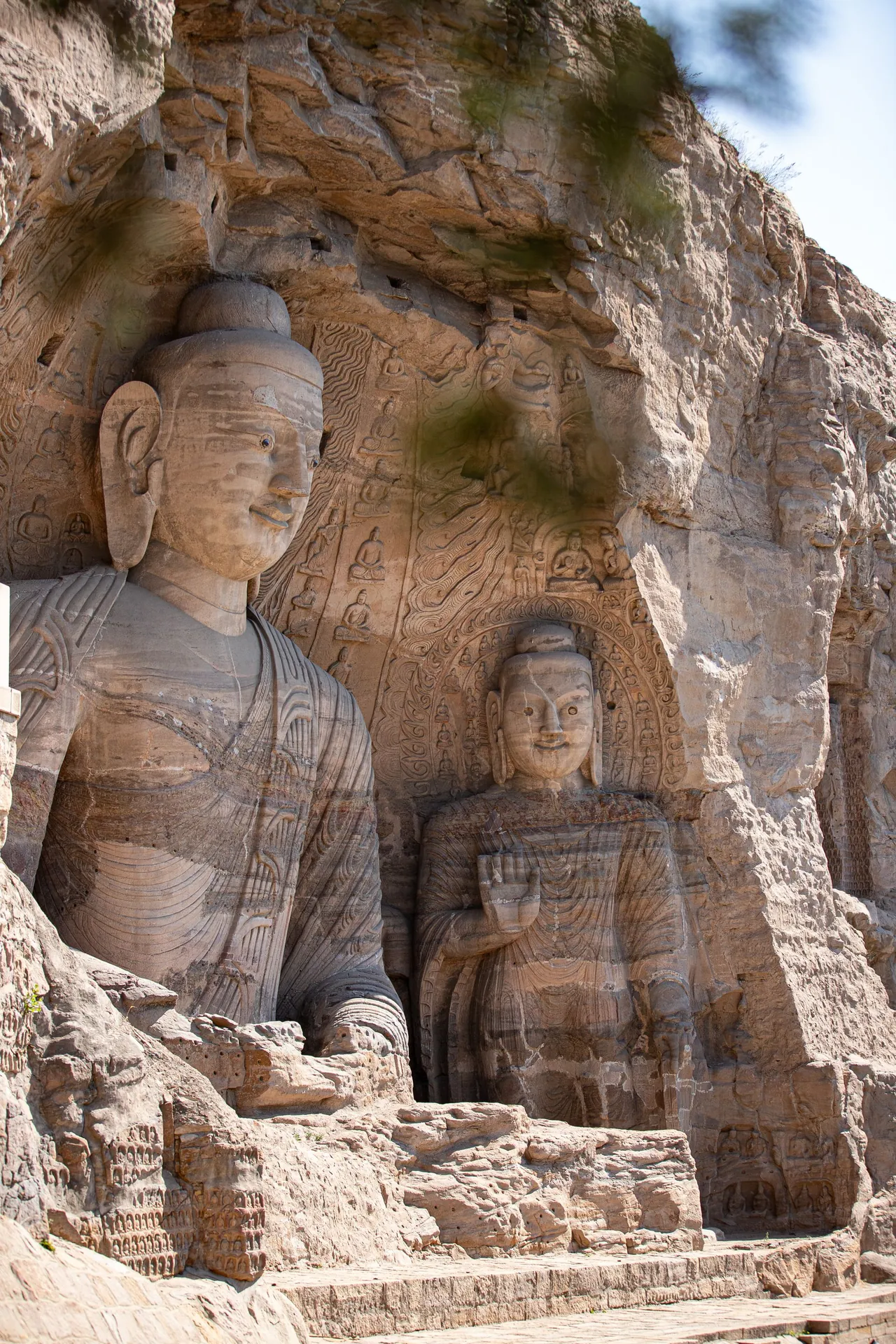
Yungang Shiku · Datong, Shanxi · 460-525 CE
The Yungang Grottoes are a monumental complex of 252 caves and 51,000 Buddhist statues carved into the sandstone cliffs near Datong between 460 and 525 CE. Commissioned by the Northern Wei emperors — the first rulers of a unified north China to embrace Buddhism as a state religion — the grottoes represent the earliest and most powerful fusion of Indian, Central Asian, and Chinese artistic traditions. The five earliest caves, the Tanyao Caves, contain colossal Buddhas up to 17 meters tall that are considered among the most important works of early Buddhist art in Asia.
The five earliest caves (Caves 16-20), carved between 460 and 465 CE under the monk Tanyao's direction, contain colossal Buddhas designed to embody the Northern Wei emperors themselves. The project was a response to catastrophe: the preceding emperor had persecuted Buddhism, and his successor, Emperor Wencheng, commissioned the statues to restore the faith — with each emperor symbolically equated with a Buddha, linking political authority with divine power.
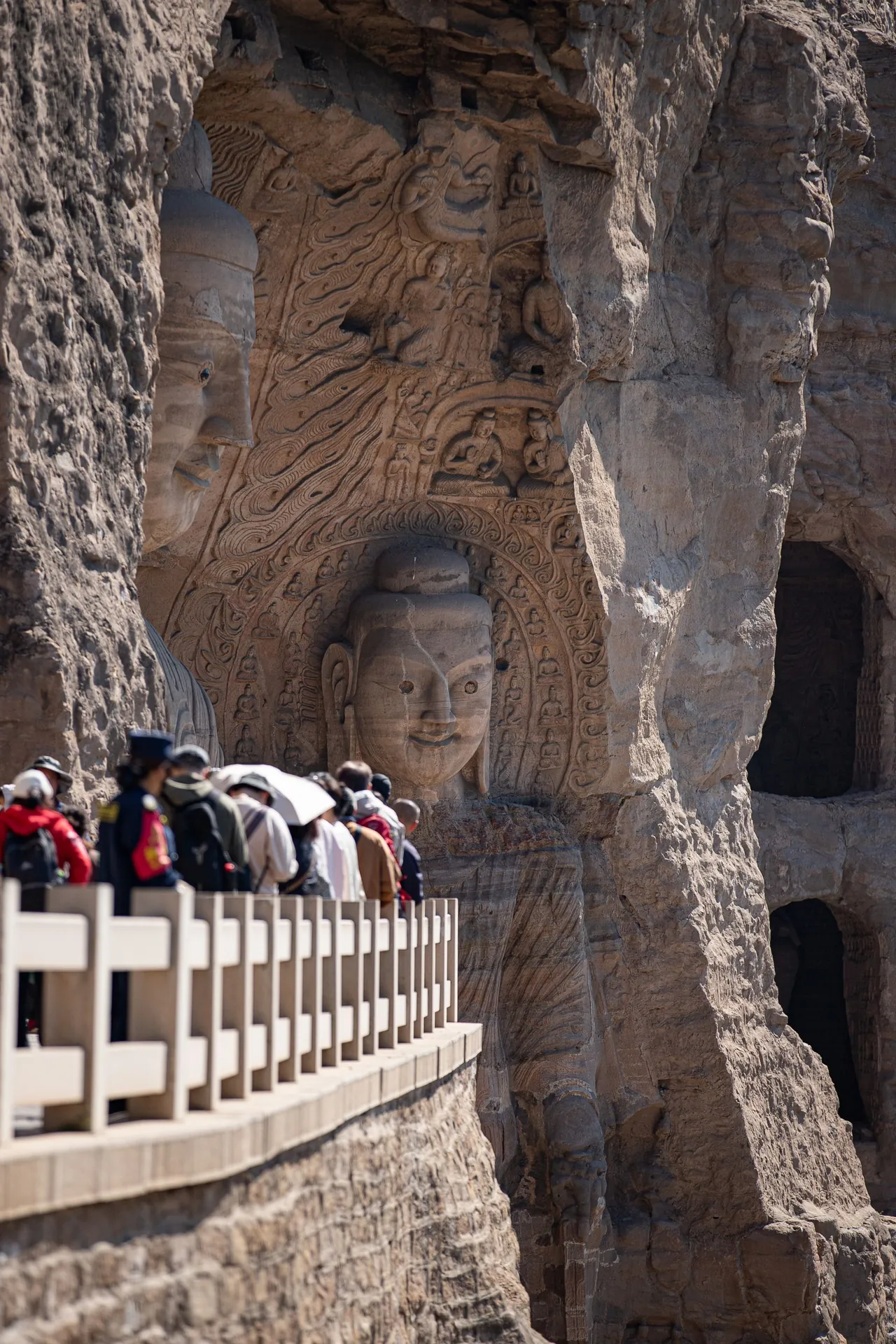
The largest figure, in Cave 20, stands 13.7 meters tall and has become the iconic image of the Yungang Grottoes; the outer wall of its chamber collapsed long ago, leaving the colossus exposed against the cliff. The statues' massive, simplified forms and their deep-set niches echo the rock-cut architecture of India's Ajanta and Bamiyan caves, transmitted along the Silk Road — but the faces are unmistakably Chinese, with the broad features of the Tuoba Xianbei rulers.
The Yungang Grottoes are the earliest major Chinese site to record the full artistic vocabulary of the Silk Road. Sculptors drew on Gandhara style (Greco-Buddhist art from present-day Pakistan) with its wavy hair and draped robes; Gupta style from India with its transparent, clinging garments; and the Central Asian styles of Sogdia and Khotan — then absorbed these foreign elements into native Chinese aesthetics.
The result is visible cave by cave: early figures wear Indian robes with Greek-influenced drapery, while later caves (470-525 CE) adopt slender, elegant proportions and Chinese facial features that would define subsequent Chinese Buddhist art. Cave 12, the 'Music Cave', carries the motif furthest — its upper walls are carved with a band of celestial musicians playing more than a dozen instruments from across Asia, including Persian lutes, Indian drums, and Chinese flutes, a frozen symphony of the Silk Road exchange.
Unlike timber buildings, the Yungang caves were created by carving away the cliff face — an architecture of subtraction. The caves reproduce timber temple interiors in stone: the central-pillar caves (notably Cave 6, completed 493 CE) contain a four-sided stone pillar carved with pagoda tiers, Buddha niches, and relief panels that imitate multi-story wooden pagodas.
Even the details follow timber logic: carved brackets, beams, and coffered ceilings replicate wooden assemblies, demonstrating that Chinese builders held the timber tradition as the standard against which all architecture was measured. The site faces the same enemy as the stone itself: the soft sandstone is vulnerable to wind erosion and rain, and conservation teams have spent decades testing water-repellent coatings and structural anchors to slow the cliffs' decay.
Best Time to Visit
May-October; Datong is cool and dry even in summer
Photography Tips
Cave 20 colossal Buddha best in morning light; wide shot from the opposite ridge
How to Get There
High-speed rail to Datong South Station, then 30-min taxi ride
The cave's outer wall collapsed centuries ago, exposing the 13.7-meter seated Buddha to the open air. The accident became an icon: the Buddha now appears to emerge directly from the cliff face, making it the most photographed statue at Yungang and the site's unofficial symbol.
By subtraction — masons and sculptors worked from the top down, carving directly into the sandstone cliff: first roughing the cave chamber, then finishing the ceiling, and finally cutting the statues out of the living rock. Scaffolding holes still visible in the cave walls show where workers stood.
The essentials are Caves 5-6 (the tallest Buddha and the richly carved central-pillar cave), Cave 9-10 (front-chamber temples), Cave 12 (the Music Cave with celestial musicians), and Cave 20 (the exposed colossus). A standard tour covers about 20 caves in 2-3 hours.