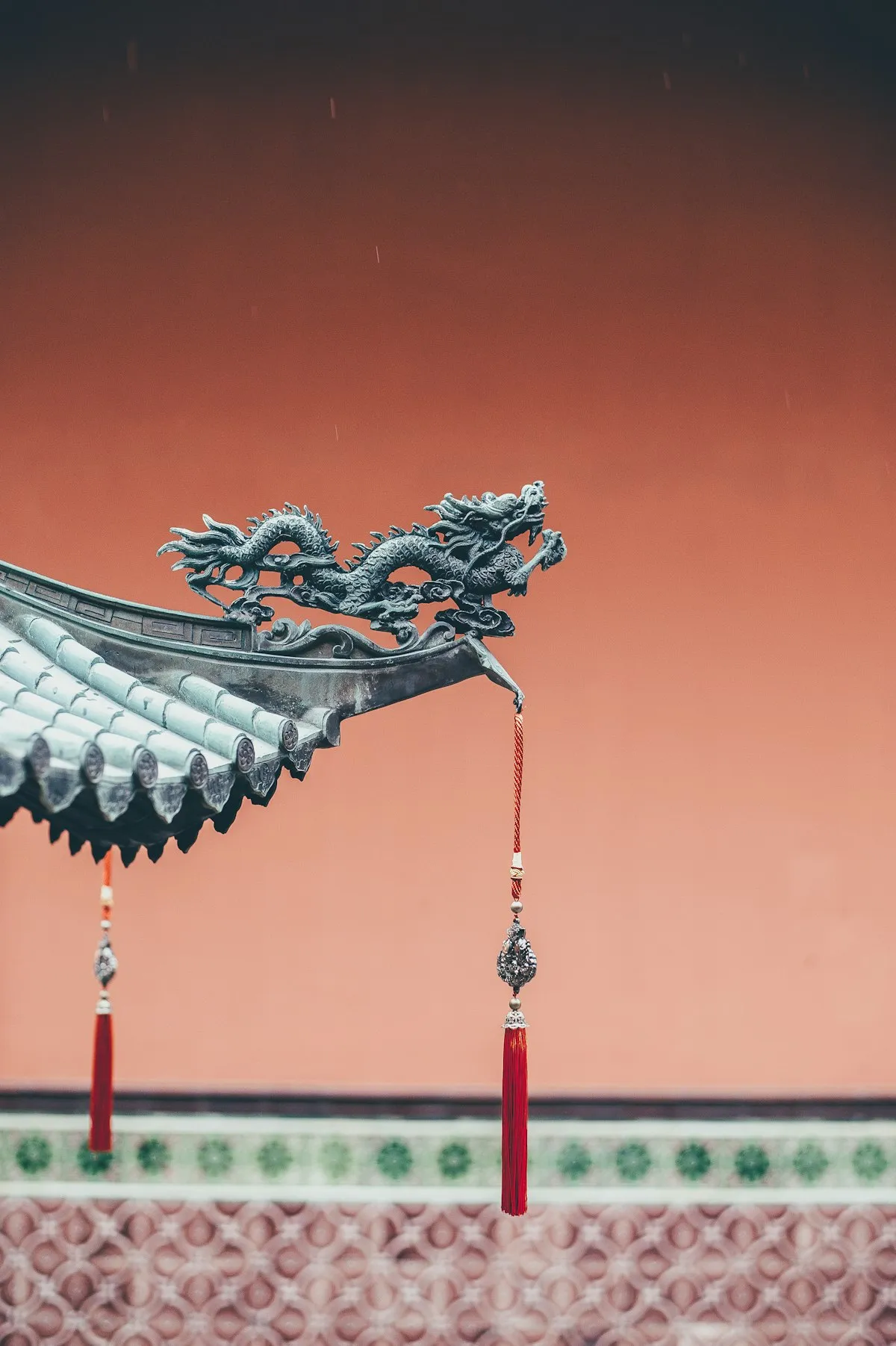
Symbolism in color, pattern, and figure
Chinese architectural decoration is a legally enforced language of rank. The ridge beasts marching along the roof are talismans that also pin down heavy glazed ridge-caps against wind; the painted beams (caihua) seal timber against moisture while announcing the building's status in three grades — dragon-and-phoenix for imperial halls, spiral scrolls for temples, landscapes for gardens. Color was regulated by law: yellow for the emperor alone, blue for heaven, green for princes, red for vitality at gates and columns. Every pattern, figure, and hue carries meaning.
| Color | Meaning | Who Could Use It | Where to See |
|---|---|---|---|
| Yellow | Center of the universe, imperial power | The emperor alone | Forbidden City roofs |
| Red | Happiness, good fortune, vitality | Palaces, temples, wealthy homes | Palace walls and columns |
| Blue / black | Heaven, the sky | Temples and imperial altars | Hall of Prayer for Good Harvests roof |
| Green | Growth, spring, harmony | Princely mansions and officials | Prince mansions of Beijing |
Colors in Chinese architecture follow a strict hierarchy rooted in the Five Elements (wuxing) cosmology: blue-green (wood, east, spring), red (fire, south, summer), yellow (earth, center), white (metal, west, autumn), and black (water, north, winter). Yellow — the color of the center — was reserved for the emperor, and yellow-glazed roofs still mark the Forbidden City's principal halls against the grey city around them.
Red, the color of fire and vitality, was believed to repel evil and was used for palace walls, columns, and gates across China — the vermillion columns of the Hall of Supreme Harmony and the Red Wall of the Forbidden City are the most famous examples. Blue symbolized heaven, so temple and altar roofs — like the Hall of Prayer for Good Harvests — were tiled in blue, while green glazes distinguished the mansions of princes from imperial yellow. The system was enforced by law: using a color above your rank was a crime.
The row of mythical beasts marching along the roof ridge is the most direct visual index of a building's rank. The sequence is fixed — a rider on a chicken leads, followed by dragon, phoenix, lion, heavenly horse, sea horse, suanni, xiezhi, douniu, and xingshi — and the number of beasts placed after the rider marked the building's importance. The Hall of Supreme Harmony carries the maximum ten; the imperial gates of the Forbidden City use nine; lesser palace halls seven; and ordinary buildings none at all.
The beasts are not decoration but talismans. The dragon summons rain to extinguish fire, the phoenix wards off misfortune, the lion embodies courage, and the fish-tailed xiezhi is the guardian of justice — each is also a ridge weight, pinning down the heavy glazed tile ridge-caps against wind. Their practical role is architectural: by weighting the ridge ends, they hold the roof structure together and prevent the sweeping eaves from lifting in storms.
The decorative painting of structural beams — caihua — is the largest continuous art surface in Chinese architecture, and it serves a double purpose: the layers of mineral pigment, lacquer, and oil seal the timber against moisture, insects, and decay, dramatically extending the life of the frame; the patterns simultaneously announce the building's rank.
Qing dynasty painting was classified into three grades: hexi (dragon-and-phoenix with gold) for imperial buildings, xuanzi (spiral-scroll patterns) for temples and official halls, and su (landscape-and-figure scenes) for gardens and private homes. The most elaborate caihua covers every beam of the Hall of Supreme Harmony in gold-dragon hexi style, while the Summer Palace's Long Corridor carries 14,000 su-style scenes of landscapes and stories — the largest painted gallery in the world. Beneath the artistry, the logic is strictly legal: paint above your rank was as illegal as building above it.
The dragon symbolizes imperial power, rain, and good fortune. Five-clawed dragons were reserved for the emperor and his buildings, while princes could use four claws and officials only three. Dragon motifs appear on roof ridges, beams, columns, and carved balustrades throughout the Forbidden City.
Yes — the layers of mineral pigment and lacquer seal the timber against moisture, insects, and decay, dramatically extending the life of structural wood. The decorative patterns follow strict rank-based categories: dragon-and-phoenix for imperial halls, floral scrolls for temples, and geometric designs for lesser buildings.
A pair sits at each important gate: the male lion with a ball under his paw symbolizes power and the universe, the female with a cub symbolizes fertility and family protection. Their fierce expressions are meant to frighten evil influences away from the threshold.