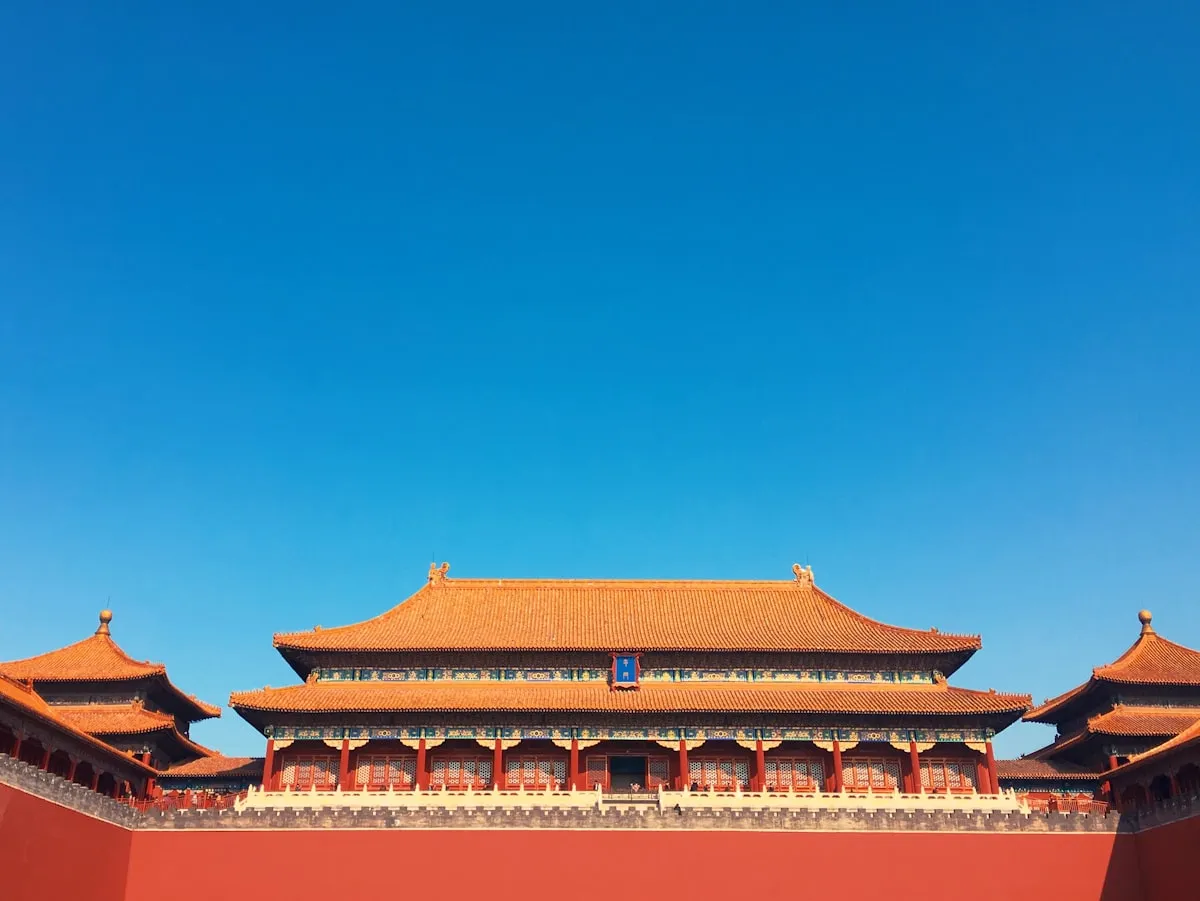
Zijincheng · Beijing · 1406-1420
The Forbidden City is the largest palace complex in the world, containing 980 buildings across 72 hectares. Built under the Yongle Emperor of the Ming dynasty, it served as the imperial palace for 24 emperors across nearly 500 years. Every aspect of its design — from the orientation to the color scheme to the number of roof beasts — communicates imperial power and cosmic order.
The palace is laid out on a strict north-south axis, with the most important halls aligned along the central line. The Outer Court (south) housed ceremonial spaces including the Hall of Supreme Harmony, while the Inner Court (north) was the emperor's residence. This axial arrangement mirrors the cosmic order, with the emperor positioned at the center of the world.
The central axis runs 960 meters from the Meridian Gate to the Gate of Divine Prowess, and extends conceptually beyond the walls to Tiananmen Gate in the south and Jingshan Hill in the north. The Outer Court's three great halls — Supreme Harmony, Middle Harmony, and Preserving Harmony — sit on a three-tiered marble platform 8 meters high, their stepped terraces forming a pyramid of architectural authority. Behind them, the Inner Court's three palaces (Qianqing, Jiaotai, Kunning) formed the private imperial household, each separated by walls and gates that controlled access layer by layer.
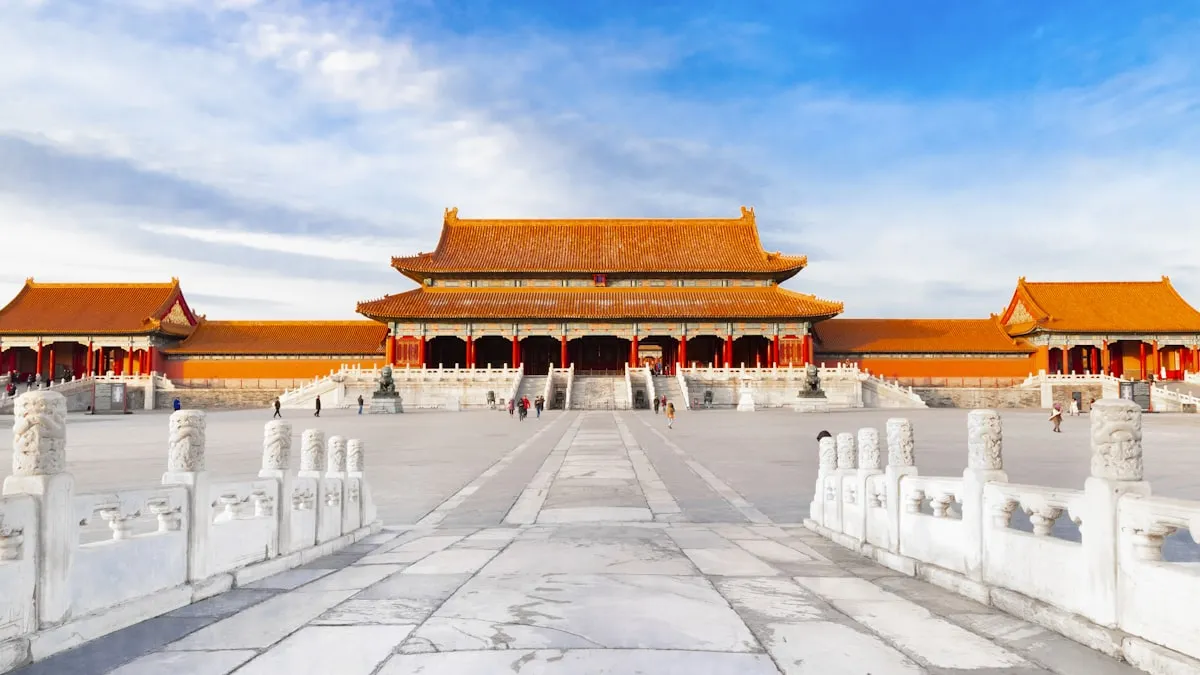
The largest hall in the complex, used for enthronement ceremonies and imperial weddings. Its double-eaved hip roof — the most prestigious roof form — is covered in yellow-glazed tiles, a color reserved for the emperor. Ten ridge beasts, the maximum permitted, crown its roof ridges.
The hall rises 35 meters above its marble terrace — the tallest building in old Beijing, deliberately exceeding nothing else within the city walls. Its 11-bay facade is the widest permitted by the building codes, and the interior is floored with 4,718 square meters of "golden bricks" (jinzhuan) fired in Suzhou, whose dense, dark surface took 729 days to produce per batch. During ceremonies, 10,000 courtiers knelt in the courtyard below while the emperor sat alone on the dragon throne — the spatial arrangement itself was the instrument of power.
Built using the standardized modular timber system (cai-fen), the palace incorporates wood from the precious nanmu tree, marble from Fangshan quarries, and specially fired golden bricks from Suzhou. The complex was constructed in just 14 years using an estimated workforce of one million laborers and craftsmen.
Nanmu timber was felled in the forests of Sichuan, Guizhou, and Yunnan — up to 3,000 kilometers away — and floated down the Yangtze and Grand Canal to Beijing, a supply chain that took years per shipment. The Fangshan marble for the three-tiered terraces was quarried 30 kilometers away and dragged over ice roads in winter. That the entire complex rose in 14 years (1406-1420) testifies to the modular system: columns, beams, and brackets were prefabricated in workshops across the empire, then assembled on site like a giant kit.
Best Time to Visit
April-May or September-October for mild weather
Photography Tips
Best exterior shots from Jingshan Park at sunrise; interior details in late afternoon golden light
How to Get There
Subway Line 1 to Tiananmen East/West; enter through the Meridian Gate
Yes — tickets require real-name advance booking and daily capacity is strictly limited. During national holidays tickets often sell out days ahead, so book online as early as possible and carry your passport for entry.
Most visitors need 3-4 hours to walk the central axis (Meridian Gate to the Imperial Garden). History enthusiasts can easily spend a full day exploring the side halls and museums — allow extra time on weekdays when crowds are smaller.
Entry is one-way: enter from the south (Meridian Gate, near Tiananmen Square) and exit from the north (Gate of Divine Prowess). From the north exit you can walk directly to Jingshan Park for the classic elevated view of the palace.